One of the questions I am often asked by new students is:
“Teacher Jenny, which music theory textbook should I buy?”
Surprisingly, my answer is usually, “None.”
After more than 20 years of teaching music theory lessons in Singapore, I have discovered that passing music theory examinations is not about collecting the greatest number of textbooks. It is about learning the right method, understanding the examiner’s expectations, and knowing how to solve questions quickly within the limited examination time.
My music theory programme is divided into two stages. During the first year, students complete Grades 1–5, while the second year focuses on Grades 6–8. Although many students join my music theory crash course in Singapore because they need to prepare within a shorter period, the teaching philosophy remains exactly the same — simplify the learning process, remove unnecessary confusion, and focus on methods that actually work in the examination.
Over the years, I have also been very fortunate that many of my students came through recommendations from friends, former students, and parents. Word of mouth has always been one of the greatest encouragements for me because it tells me that my teaching methods have genuinely helped students achieve their goals.
Among all my students, there is one unforgettable experience that I still remember vividly today.
One day, an adult student arrived for her very first music theory lesson carrying a huge XL-sized luggage case. I was completely puzzled. I wondered why someone would bring a luggage case to a one-hour music theory lesson!
When she unzipped the luggage, I was absolutely stunned.
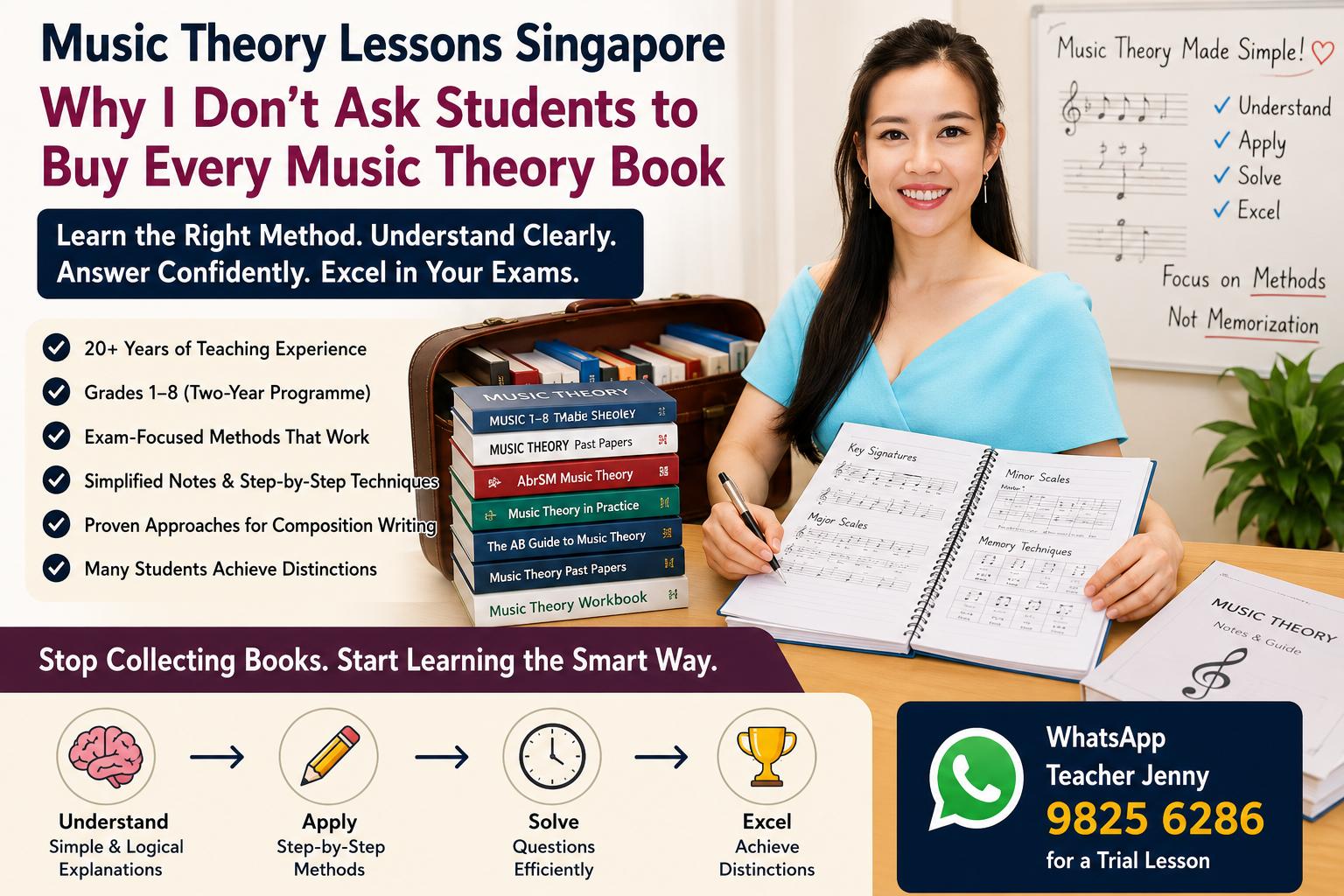
Inside was an entire library of music theory books. There were textbooks, workbooks and revision guides from almost every publisher available in the music shops. She smiled and said, “I bought everything because I don’t know where to start. Could you please tell me which books I should study first?”
For a few seconds, I honestly didn’t know whether to laugh or cry.
The amount of books was overwhelming, even for me!
I carefully selected a few books that contained fewer lengthy explanations and less wordy text. I explained to her that sometimes reading more instructions does not necessarily make learning easier. In fact, many students become even more confused because every publisher explains the same concept in a slightly different way.
I also shared something that often surprises many students.
I told her that when I teach, I rarely follow every page of the textbook word for word. Instead, I always think from the examiner’s perspective and from my own classroom experience. Throughout the years, I have refined many topics into much simpler, step-by-step methods that allow students to solve problems efficiently without becoming overwhelmed by complicated explanations.
For example, in Grade 5 Music Theory, there is a question that asks students to identify which clef belongs to a particular minor scale. Many textbooks require students to memorise key signatures together with numerous accidentals before they can even begin solving the question.
My approach is completely different.
Instead of asking students to memorise large amounts of information, I teach them how to link the key signatures using simple memory techniques. From there, they learn how to work out the required accidentals by counting logical steps. I also provide organised charts showing the possible harmonic and melodic minor patterns so that students can identify the correct answers confidently. Rather than depending entirely on memory, they learn a reliable process that they can apply during the examination.
When students understand the logic, they no longer panic whenever they encounter unfamiliar questions.
The same philosophy continues throughout Grades 6–8.
During the past two decades, I have continually analysed examination questions and experimented with different approaches to music composition teaching. Through teaching many students over the years, I have identified writing approaches that consistently produce strong examination results. Instead of asking students to study every possible composition style found in every textbook, I guide them towards the techniques and approaches that have repeatedly helped students score well in the examinations.
This allows students to spend their precious study time mastering the methods that are most useful for examination success instead of becoming overwhelmed by too many possibilities.
Many people ask why I only teach certain topics in greater detail.
The answer is simple.
Every lesson is carefully selected based on what gives students the greatest improvement in their examination performance. Rather than trying to cover everything equally, I focus on teaching the concepts that provide the highest learning value and the biggest impact on examination scores.
For students who are interested in learning more about my composition writing methods for higher-grade music theory examinations, you are welcome to visit my YouTube channel, where I regularly share free tutorials and examination tips.
Watch my Music Theory Composition Tutorial??
Please don’t misunderstand me — I believe music theory books are valuable resources. They contain excellent information and provide comprehensive coverage of the syllabus.
However, because they are designed to be comprehensive, they often explain concepts in great depth. During an actual examination, students have very limited time. If they try to work through the same lengthy thinking process described in many textbooks, they may struggle to finish the paper within the allocated time.
This is exactly why attending music theory lessons in Singapore can make such a significant difference.
My role as a teacher is to organise, summarise and simplify the learning process. I break complicated concepts into small, manageable steps so that students can understand them quickly, apply them confidently and complete their examination papers within the time limit without making unnecessary detours.
This is also the reason why I do not require my students to purchase numerous music theory books. Over the years, I have developed my own music theory notes and guidebooks that summarise the essential concepts and go straight to the point. These teaching materials are continually refined based on classroom experience and examination feedback, allowing students to focus on what truly matters.
I am delighted that many students who have followed this systematic approach have gone on to achieve Distinctions in their music theory examinations.
If you are looking for music theory lessons in Singapore or a structured music theory crash course in Singapore, and you would like to learn through clear, logical and efficient methods instead of memorising countless pages of textbooks, I would be delighted to help you on your musical journey.
WhatsApp teacher Jenny 98256286 for a trial lesson.

