How Art Can Transform the Interpretation of ARSM Diploma Piano Pieces
Helping Students See the Music Before They Play It
Many diploma piano students preparing diploma piano pieces concentrate intensely on notes, fingering, tempo and technical accuracy. These are essential, but they are only the beginning of a convincing performance.
One problem I frequently notice is that students use the same interpretation for every piece. They may apply a similar tone, articulation, pedaling and emotional intensity to Bach, Mozart, Haydn, Chopin and Schumann. Although the playing may be accurate, the character of each musical period is lost.
In my ARSM diploma piano lessons in Singapore, I help students understand that interpretation must begin with the world in which the music was created. A Baroque fugue, a Classical sonata and a Romantic character diploma piano piece do not speak the same language. Each reflects different ideas about society, art, architecture, emotion and the purpose of music.
One effective way to develop this understanding is through paintings and visual art. When students look at the colours, composition, movement, atmosphere and focal points in an artwork, they begin to form a mental picture of the music. They no longer play only the notes printed on the page; they learn to imagine the scene, culture and emotional world behind the diploma piano composition.
Baroque Music in ARSM diploma piano: Many Important Details Within One Magnificent Design
When teaching Bach, I sometimes show students images of richly decorated Baroque churches. Their interiors may contain columns, sculptures, frescoes, curved architectural lines, gilded ornamentation and dramatic contrasts of light and shade. At first, the eye may be overwhelmed by the amount of detail. Gradually, however, we see how every element contributes to one unified design.
This provides a useful visual analogy for Bach’s polyphonic writing.
In a fugue or invention, several melodic lines may unfold at the same time. One voice introduces the subject; another answers it; later, the subject may return in a different register while countersubjects and accompanying lines continue around it. Like the details inside a Baroque church, no voice should be treated as meaningless decoration. Each line has a function and must be heard as part of the complete structure.
Bach’s working life was closely connected with churches, courts and musical education. Not every keyboard work was written for a church service, but his sacred environment and his deep knowledge of organ and choral writing formed an important part of his musical world. At diploma piano level, students should therefore avoid playing Bach as though it were a Romantic melody with a blurred accompaniment underneath.
For example, in preludes and fugues from The Well-Tempered Clavier, such as the Prelude and Fugue in C minor, BWV 847, students must identify the subject and recognise where it moves from one voice to another. In the Prelude and Fugue in D minor, BWV 851, rhythmic energy and contrapuntal clarity are more important than heavy pedaling or exaggerated rubato. In works such as the French Suites or Partitas, students must also recognise the character of the dance movements and the elegance of Baroque ornamentation.
During my ARSM lessons, I may ask a student:
?   Which voice is speaking at this moment?
?   Which voice is answering?
?   Is the subject in the soprano, alto, tenor or bass?
?   Which line should come forward, and which line should remain clear but less prominent?
?   Does the ornament sound graceful and integrated, or does it interrupt the musical line?
This changes the student’s listening. The hands are no longer merely playing several notes together. Each hand—and sometimes each finger—takes part in a musical conversation.
Classical Music: A Clear Main Figure Supported by an Elegant Background
For music by Mozart and Haydn, a different type of visual image is helpful. Jean-Honoré Fragonard’s famous painting The Swing, painted around 1767–68, belongs to the Rococo style. It shows a graceful central figure surrounded by an elaborate garden scene. The eye is naturally drawn towards the young woman on the swing, while the trees, statues, shadows and other figures create the setting around her.
Although Rococo art and the Classical musical style are not identical, this painting offers students a memorable analogy for homophonic texture: a clearly projected melody supported by accompaniment.
In a Mozart or Haydn sonata, the right-hand melody may be the principal character, while an Alberti bass or chordal pattern provides the background. The accompaniment must remain alive, elegant and rhythmically controlled, but it should not compete with the melodic line. Just as the garden in The Swing supports the central figure, the accompaniment frames the melody and allows it to shine.
This can be heard in ARSM diploma piano works such as Mozart’s Sonata in C major, K. 545, Sonata in B-flat major, K. 333, and Sonata in F major, K. 332. It is also relevant to Haydn sonatas, in which a simple musical idea may be transformed through wit, contrast, surprise and lively dialogue.
Paintings of aristocratic gatherings, dances and chamber-music performances also help students imagine the social world surrounding much eighteenth-century music. Mozart and Haydn both worked within systems of courtly and aristocratic patronage, and their music often reflects balance, refinement, sociability, humour and conversation.
Therefore, Classical music should not sound heavy or continuously dramatic. Students need to recognise:
?   the rise and fall of a balanced phrase;
?   the difference between a musical question and its answer;
?   elegant articulation and transparent pedaling;
?   sudden contrasts that create humour or surprise;
?   the hierarchy between melody and accompaniment; and
?   the character of a musical conversation between different registers.
For example, the opening of a Mozart sonata may be imagined as a refined speaker making a graceful statement. A contrasting second subject might sound like another character entering the conversation. A sudden pause, dynamic change or unexpected harmony may represent a dramatic gesture, a witty interruption or a change of mood.
This type of imagery helps an ARSM student shape phrases with purpose instead of playing every note at the same level.
Romantic Music: The Inner World of the Individual
By the Romantic period diploma piano works, composers increasingly used music to express personal longing, memory, imagination, conflict and emotional experience. Music was no longer shaped only by religious duties or courtly entertainment. Public concerts, domestic music-making and the image of the individual artist became increasingly important.
To help ARSM diploma students enter this world, I may show them Romantic paintings by Caspar David Friedrich. In Wanderer above the Sea of Fog, a solitary figure stands before a vast, mist-covered landscape. In Monk by the Sea, a tiny human presence faces an immense and mysterious natural world. These paintings do not simply record a place. They invite us to experience solitude, wonder, uncertainty, reflection and the sublime.
This is closely related to the emotional world of many Romantic diploma piano pieces.
For example, in one of the ARSM diploma piano repertoires, Chopin’s Nocturnes often resemble an intimate inner voice. The melody must sing with freedom and tenderness, while the accompaniment creates depth, atmosphere and harmonic colour. In Schumann’s Kinderszenen or Fantasiestücke, rapid changes of character may suggest memory, imagination or different sides of the composer’s personality. Brahms’s late piano pieces, such as the Intermezzo in A major, Op. 118 No. 2, require warmth, restraint and emotional depth rather than superficial sentimentality.
In lyrical Romantic music, phrases are often broader and the harmonic rhythm may sometimes feel more spacious than in a continuously moving Baroque sequence or a lively Classical passage. This does not mean that all Romantic harmony changes slowly. Instead, students must listen to how the composer uses delayed resolution, chromatic colour, inner voices and longer melodic arcs to intensify emotion.
A diploma piano student who changes harmony too abruptly, breaks every phrase into small sections or uses rubato without direction may destroy this sense of emotional continuity. I therefore ask students to imagine the musical line as a long breath or as a distant landscape gradually appearing through mist.
The painting gives the phrase somewhere to travel.
Turning Music Appreciation into Practical Interpretation
Music appreciation is not separate from piano technique. It directly affects how a student plays.
When a student understands the visual and historical background of a work, practical decisions become clearer:
?   Tone: Should the sound be transparent, elegant, brilliant, intimate, dark or orchestral?
?   Voicing: Is every contrapuntal line important, or is there one principal melody above an accompaniment?
?   Articulation: Does the music require clarity and dance-like energy, refined Classical speech, or a long Romantic legato?
?   Pedalling: Should resonance be used sparingly for clean textures, or more generously to create colour and atmosphere?
?   Rubato: Does flexibility grow naturally from the phrase, or is it being added merely for effect?
?   Phrasing: Is the line built from short balanced gestures or from a long emotional arc?
These questions are particularly important in ARSM diploma piano pieces, because diploma-level performance requires more than technical security. The performer must demonstrate stylistic awareness, musical judgement and the ability to communicate the character of contrasting works across an entire recital programme.
If every piece is played with the same touch, pedal and emotional approach, the programme may sound technically competent but artistically one-dimensional. A successful ARSM performance should allow the listener to enter several different worlds.
My Approach to ARSM Diploma Piano Lessons in Singapore
In my ARSM diploma piano lessons, I do not teach interpretation as a list of dynamics to copy. I help students understand why a phrase should be shaped in a certain way and how a composer’s background, artistic period and musical language influence the sound.
We may study a painting, identify the main subject and background, compare visual layers with musical texture, or imagine different characters speaking through a phrase. We then translate those observations into practical skills such as voicing, tone production, pedaling, articulation, rhythmic control and phrase direction.
This approach is especially helpful for adult diploma piano students and returning pianists. Instead of relying only on instinct, they develop a clear method for interpreting unfamiliar repertoire. They learn how to examine a score, recognise its stylistic features and make musical decisions independently during home practice.
The purpose is not to claim that a particular painting has one exact musical equivalent. Art becomes a bridge: it helps students visualise qualities that can otherwise feel abstract. A richly layered church interior may illuminate Bach’s counterpoint; a graceful Rococo scene may clarify Classical melody and accompaniment; and a solitary Romantic landscape may inspire a longer, more inward musical phrase.
When students can see the music in their imagination, their performance becomes more natural, convincing and memorable.
The Polyphonic Splendour of a Baroque Church
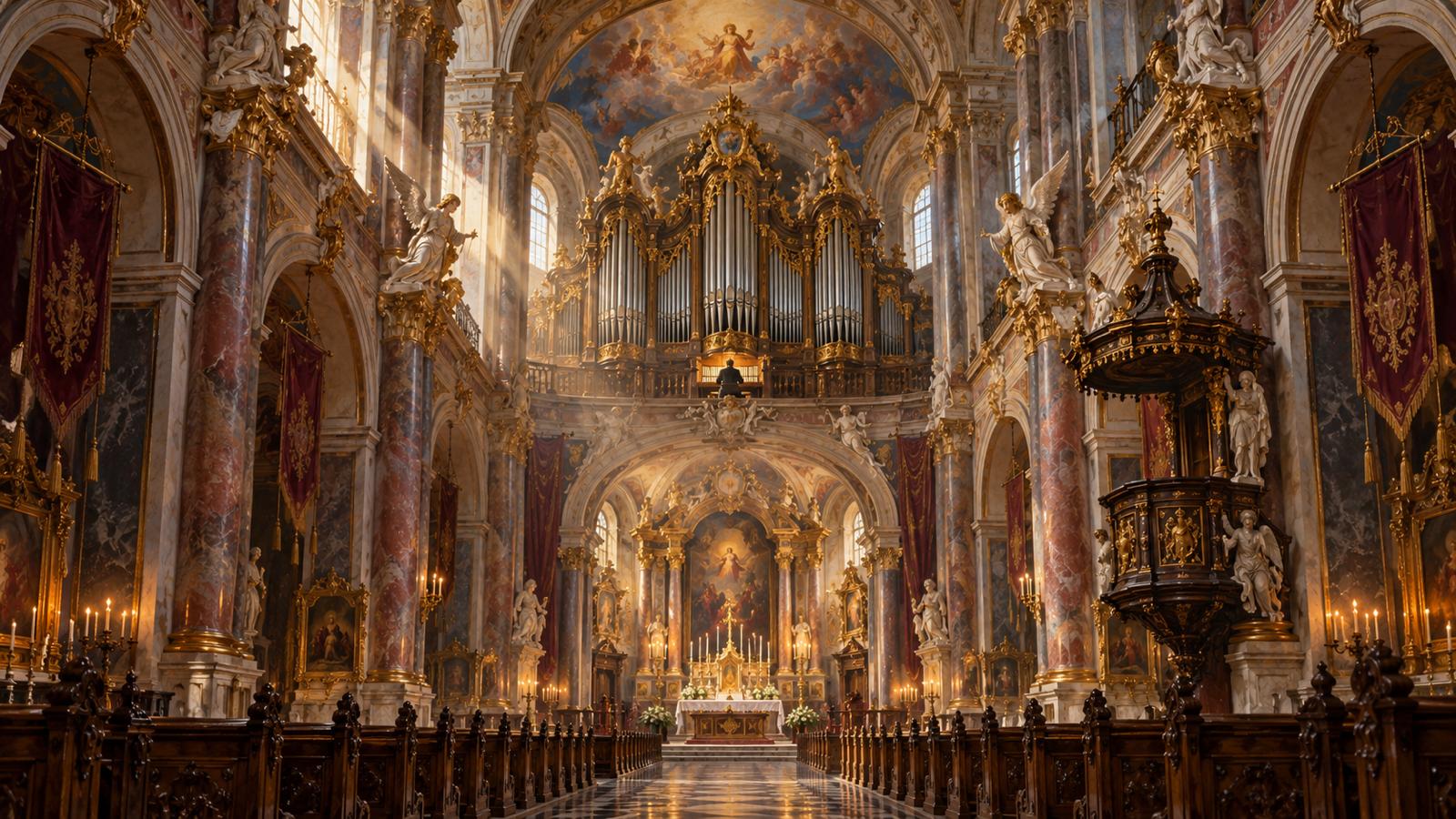
This is an original Baroque-style artwork created for your article. The richly decorated church, organ pipes, sculptures, columns and frescoes represent the many independent melodic lines in Bach’s polyphonic music. Each element is important, yet all the details combine into one magnificent and unified structure—just like the subjects, countersubjects and contrapuntal voices in a Bach fugue.
The Graceful Swing: Melody and Accompaniment
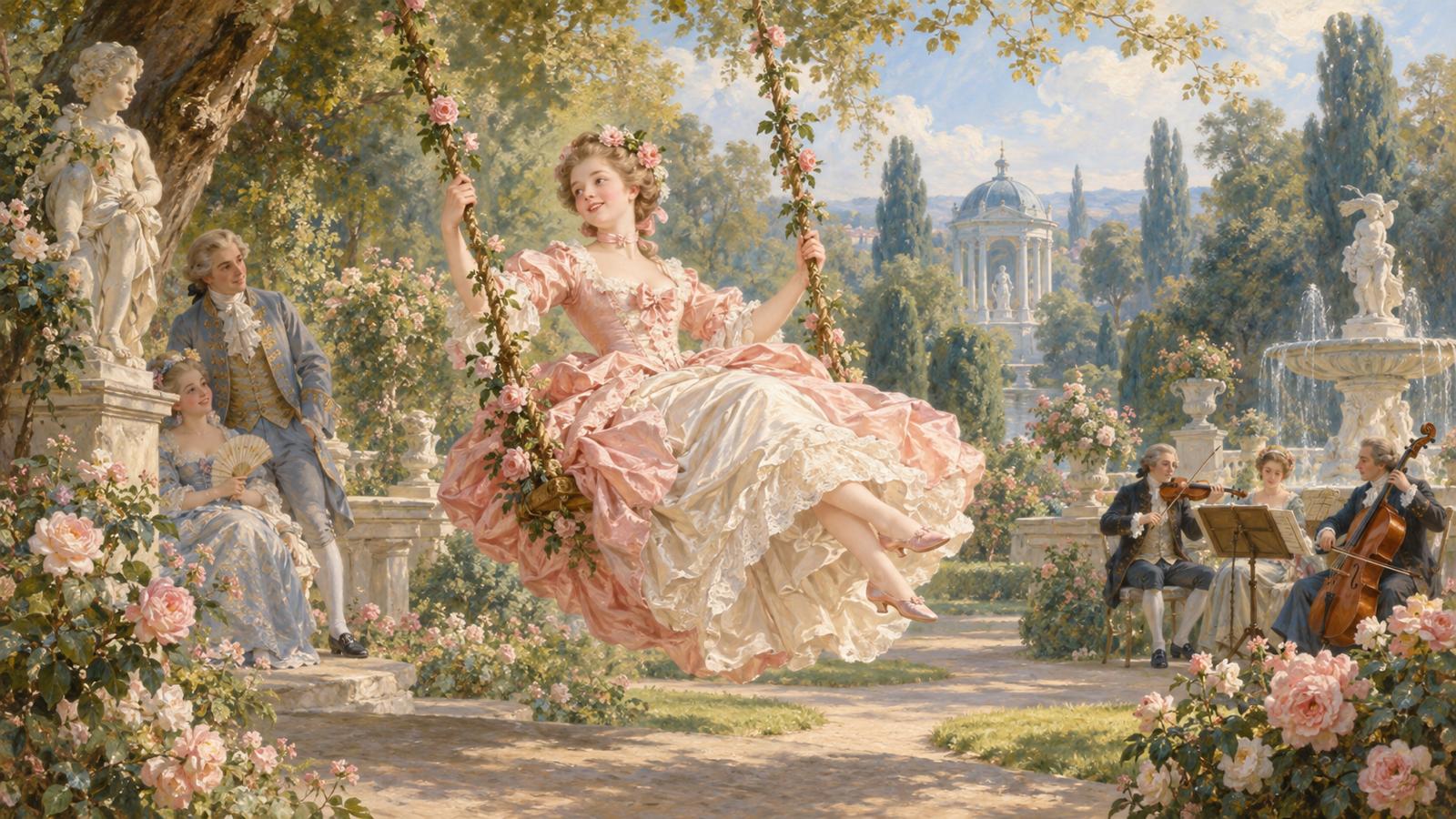
This is an original Rococo-style artwork inspired by Fragonard’s The Swing. The woman on the swing represents the clear principal melody, while the garden, companions and chamber musicians form the supporting accompaniment—similar to the homophonic texture found in Mozart’s and Haydn’s Classical piano music.
Solitude Beyond the Mist

This original Romantic-style artwork is inspired by the contemplative landscapes of Caspar David Friedrich. The solitary man, distant mountains, moonlight and mist represent personal reflection, longing and the innermost emotions often expressed in Romantic piano music.
The winding path and expansive landscape also suggest the long lyrical phrases and gradually unfolding harmonies found in works by Chopin, Schumann and Brahms
Coming Next Month
In next month’s article, I will continue this journey by exploring Post-Romanticism, Impressionism and modern art, and how their colours, perspectives and changing ideas can help students interpret later diploma piano pieces.
We will consider how blurred outlines and changing light may relate to Impressionist harmony, how richer colours can inspire tone production, and how modern art can help us understand rhythmic energy, fragmentation and unconventional musical structures.
Students who wish to prepare their ARSM diploma piano pieces with a deeper understanding of style, technique and musical interpretation are welcome to WhatsApp 98256286 to enquire about ARSM diploma piano lessons in Singapore with Teacher Jenny Soh.

